Play Games and Earn LUCK.


Snake game on Rollspace is a crypto betting game built on one of the most recognisable concepts in gaming history. Instead of controlling the snake yourself, you place a bet, roll two dice, and watch the snake travel across a winding board — landing on a multiplier that either grows your stake or shrinks it.
Everyone has played Snake in some form — whether on an old Nokia phone, a calculator, or a browser tab during a slow afternoon. The premise is one of the most intuitive in gaming: a snake moves, and where it lands matters. Rollspace takes that familiarity and turns it into a fast-paced, dice-driven game where every roll carries real stakes. You are not controlling the snake. You are betting on where it lands.
This guide covers everything: how the game works, what the board means, how risk levels change your odds, how to read results, and how to get started with crypto if you never have before.

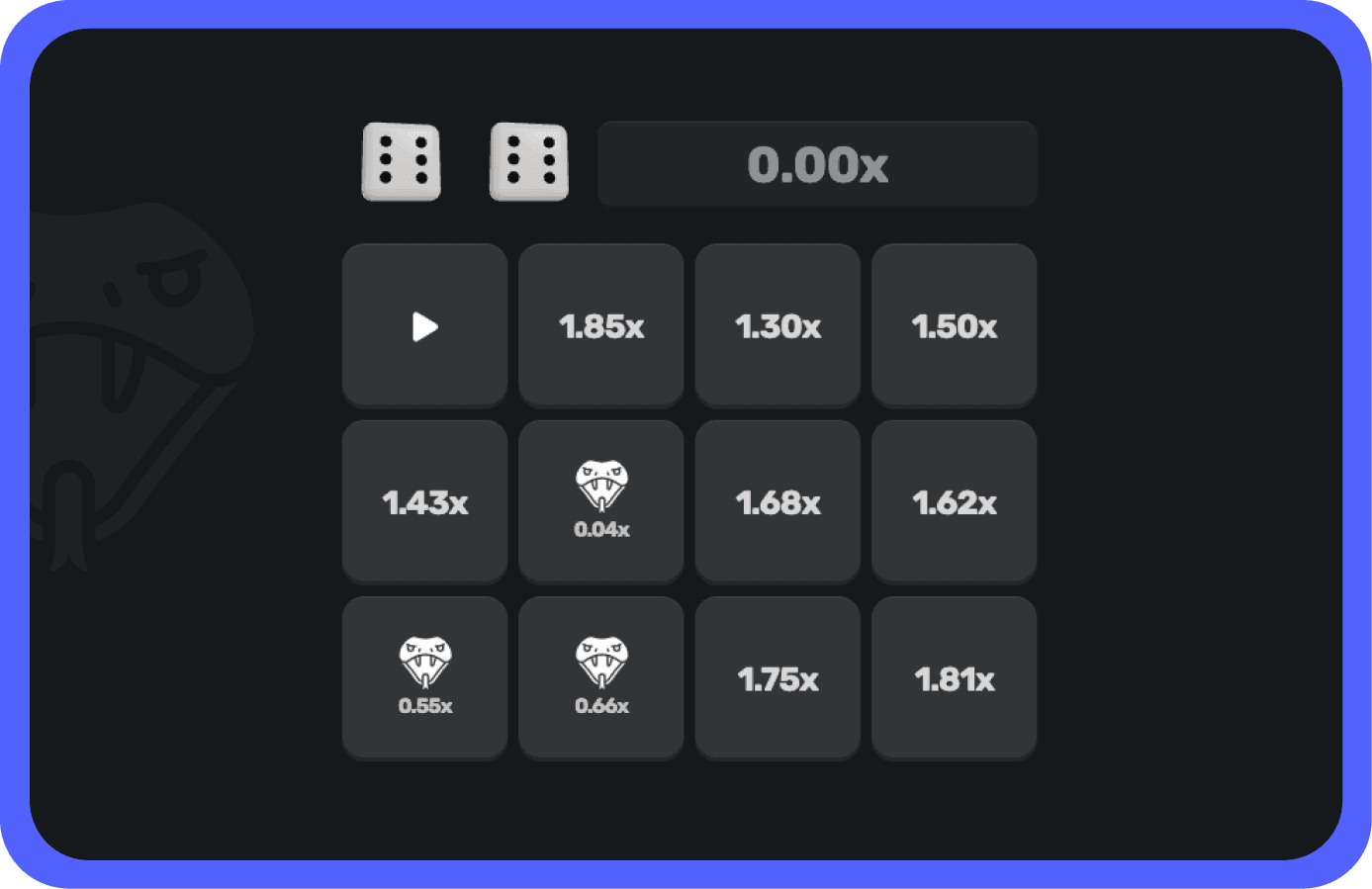
Snake on Rollspace is a dice-based betting game played on a board of 12 squares arranged in a winding path. You place a bet, choose a risk level, and roll two dice. The combined total of both dice — anywhere from 2 to 12 — determines how many steps the snake takes along the board. The square it lands on has a multiplier value assigned to it. That multiplier is applied to your bet to produce your payout.
Every square on the board shows one of two things: a multiplier number (1.85x, 10x, 100x, etc.) or a snake icon. A multiplier number means that square is a winning position — your bet is returned multiplied by that value. A snake icon means it is a losing position — only a small fraction of your bet, sometimes as little as 1%, is returned.
The result is determined entirely by the dice. You have no control over where the snake lands once the dice are rolled. What you do control is how much you bet and which risk level you play on — and that choice shapes every outcome on the board.
The entire game is played on a board of 12 squares. These squares are arranged in a winding snake-shaped path that loops across the screen in three rows, doubling back on itself. Think of it like a conveyor belt that goes right, then curves, then comes back the other way.
The path is divided into three sections:
Here is the important thing to understand: the step number and the visual position on screen are not the same. Because the path winds back, square 11 and square 12 are in the middle row visually, even though they are near the end of the path. What matters is the dice total — that number tells you exactly which square the snake lands on, regardless of where it sits on the screen.
Each of the 12 squares displays one of three things:
Square 1 is always the starting point. Since the minimum dice total is 2, the snake always moves at least one step forward from the start and can never finish there. Every round ends on squares 2 through 12.
1. Set your bet amount
Enter how much you want to wager in the bet input field. You can use the minimum and maximum shortcuts to set the limits quickly. Your bet must be within the allowed range for the game.
2. Choose your risk level
Select Low, Medium, or High from the risk selector. This is covered in detail in the next section. If you are unsure, start with Low.
3. Hit the Roll button
The game sends your bet to the server, which rolls two dice and determines the result. The dice values appear on screen with an animation — you can see both individual numbers.
4. Watch the snake move
Starting from square 1, the snake travels forward one step at a time. Each square lights up as the snake passes through it, with a short sound effect for each step. You watch it move across the board in real time until it reaches the final position.
5. See your result
The final square flashes green if it is a winning position, or red if it is a losing one. The multiplier for that square appears in large text in the center panel between the dice. Your winnings are calculated as:
Payout = Bet Amount × Multiplier
For example: a 0.01 ETH bet landing on a 1.85x square returns 0.0185 ETH. The same bet landing on a 0.04x square returns 0.0004 ETH — nearly nothing.
Risk level is the single most impactful choice in the game. It does not change the dice — both dice are still completely random on every setting. What it changes is the multiplier assigned to each square. A dice roll of 7 always moves the snake 7 steps, but the payout for landing on step 7 is completely different depending on your risk level.
This means you can think of risk level as choosing the reward structure you are playing within. Low risk trades big wins for consistency. High risk trades consistency for the possibility of massive wins.
On Low risk, the majority of the board is profitable. Most squares return more than your original bet, and the losing squares return a significant portion rather than wiping you out. This setting is well-suited for:
| Dice Total | Multiplier |
|---|---|
| 1 | Start |
| 2 | 1.85x |
| 3 | 1.30x |
| 4 | 1.50x |
| 5 | 1.43x |
| 6 | 0.04x 🐍 |
| 7 | 1.68x |
| 8 | 1.62x |
| 9 | 0.55x 🐍 |
| 10 | 0.66x 🐍 |
| 11 | 1.75x |
| 12 | 1.81x |
9 of the 11 possible landing squares are winners on Low risk. The three losing squares — positions 6, 9, and 10 — still return 4%, 55%, and 66% of your bet respectively. Even a bad roll on Low risk does not destroy your balance.
Medium risk removes some of the safety net. More squares are losing positions, and several of those losing squares return only a fraction of your bet. However, two squares now carry genuinely high multipliers: 10x at position 4 and 10.92x at position 10. These are the targets that make Medium risk feel rewarding when they hit.
| Dice Total | Multiplier |
|---|---|
| 1 | Start |
| 2 | 2.00x |
| 3 | 0.30x 🐍 |
| 4 | 10.00x |
| 5 | 0.50x 🐍 |
| 6 | 0.81x 🐍 |
| 7 | 0.92x 🐍 |
| 8 | 1.04x |
| 9 | 1.17x |
| 10 | 10.92x |
| 11 | 0.72x 🐍 |
| 12 | 0.66x 🐍 |
Only 4 of the 11 landing squares are profitable at 1x or above. Most rolls will come back below your bet. But landing on position 4 or 10 — a dice roll of 4 or 10 — returns 10x or nearly 11x. A single good roll on Medium risk can cover many previous losses.
High risk is a completely different game. Nearly every square is a losing position, and most of the losing squares return almost nothing — 1%, 2%, 7%, 9% of your bet. But three squares hold enormous multipliers that are rare in any crypto game: 50x at position 3, 75x at position 11, and 100x at position 10.
| Dice Total | Multiplier |
|---|---|
| 1 | Start |
| 2 | 0.02x 🐍 |
| 3 | 50.00x |
| 4 | 0.01x 🐍 |
| 5 | 0.07x 🐍 |
| 6 | 0.03x 🐍 |
| 7 | 0.09x 🐍 |
| 8 | 0.08x 🐍 |
| 9 | 0.17x 🐍 |
| 10 | 100.00x |
| 11 | 75.00x |
| 12 | 0.05x 🐍 |
Only 3 of the 11 landing squares return anything meaningful on High risk, and only 2 of those are genuinely large wins. The reality of High risk is that most sessions involve many consecutive small losses — but a single roll landing on position 10 turns 0.001 ETH into 0.1 ETH. That possibility is what players come to High risk for.
Two six-sided dice are rolled each round. Each die can land on 1 through 6, so the combined total ranges from a minimum of 2 to a maximum of 12. The snake moves exactly that many steps.
Some totals are more likely than others. A total of 7 has the most possible dice combinations (1+6, 2+5, 3+4, 4+3, 5+2, 6+1), making it the most common outcome. Totals of 2 and 12 each have only one combination (1+1 and 6+6), making them the rarest. This is standard two-dice probability and is the same for every game, every round.
Once the animation completes:
The center panel between the dice shows the final multiplier as a number, displayed clearly so there is no ambiguity about the outcome. Your account balance updates immediately.
The outcome of every roll is determined by random dice. No strategy eliminates the house edge or guarantees a profit. What strategies do is change the shape of your session — how quickly you might run out of funds, how big your swings are, and how you respond to wins and losses.
Bet the same amount every round, regardless of what happened on the previous roll. This is the most straightforward approach and the most sustainable over time. It removes emotion from stake sizing — you are not chasing losses or pressing after wins. It works on any risk level and is a strong default choice.
Best for: Anyone who wants a consistent, manageable session.
After every losing roll, double your stake. When a winning roll eventually comes, it covers the total of all previous losses and returns a profit equal to your original base bet.
Example on High risk, starting with 0.001 ETH:
| Round | Bet | Result | Running Loss |
|---|---|---|---|
| 1 | 0.001 ETH | 0.02x (loss) | -0.001 ETH |
| 2 | 0.002 ETH | 0.01x (loss) | -0.003 ETH |
| 3 | 0.004 ETH | 0.09x (loss) | -0.007 ETH |
| 4 | 0.008 ETH | 100x (win) | +0.793 ETH profit |
When it works, it works dramatically. The danger is the exponential growth of the required bet. After 8 consecutive losses, your 9th bet needs to be 256 times your original stake to break even. On High risk, 8 losing rolls in a row is not unusual at all. Always decide your stop-loss limit before you start — the amount you are willing to lose before stopping — and do not deviate from it.
Best for: Players with a large bankroll relative to their starting bet, and the discipline to stop when the stop-loss is reached.
Set the risk to Low, choose a flat bet, and play consistently. The majority of rolls return a profit, losses are small even when they happen, and you accumulate a large number of rounds without dramatic swings. This approach is ideal for exploring the game without significant risk to your balance.
Best for: New players, conservative players, or anyone who wants to play for an extended session.
On High risk, set your individual bet to approximately 0.5%–1% of your total bankroll. At this size, a full run of 10 consecutive losses costs only 5%–10% of your balance — survivable. The goal is to outlast the losing streak long enough to land on a 50x, 75x, or 100x square. One hit at that size pays for an enormous number of losing rounds.
Best for: Players who understand they will lose frequently and are specifically chasing the large multipliers.
Rollspace runs on the Base L2 Network — a fast, low-cost blockchain built on top of Ethereum. To play, you need a crypto wallet with Base ETH. The most widely used wallets are MetaMask (available as a browser extension on desktop or as a mobile app) and Trust Wallet (mobile).
If you do not have a wallet yet, download MetaMask or Trust Wallet and follow their setup instructions to create one. Keep your seed phrase stored somewhere safe and private — this is the master key to your wallet.
Step 1 — Connect your wallet to Rollspace
Go to Rollspace and click "CONNECT" in the top right corner of the screen. A list of supported wallets will appear. Select yours. On the next screen, click "SIGN" — this asks your wallet to confirm that you are the owner. Signing does not move any funds and does not cost gas. It is purely a verification step.

Step 2 — Open your gaming wallet and deposit
Once connected, click the currency symbol in the top right corner to open your Rollspace gaming wallet. Enter the amount of Base ETH you want to deposit, click "DEPOSIT", and confirm the transaction in your wallet when prompted. Your balance will appear in your Rollspace account within moments.

From there, navigate to the Snake game and you are ready to place your first bet.
Base is a separate network from Ethereum mainnet. ETH on Ethereum mainnet and ETH on Base are the same asset, but they live on different networks. You need Base ETH specifically — ETH that has been moved over to the Base network — to use Rollspace.
If your ETH is currently on mainnet (in MetaMask, or withdrawn from a centralized exchange to your wallet), you move it to Base using a bridge. A bridge is a tool that locks your ETH on one network and releases the equivalent amount on another.
Step 1 — Bridge ETH from mainnet to Base
Go to superbridge.app/base and connect your wallet. Select Ethereum mainnet as the source and Base as the destination. Enter the amount you want to bridge and confirm the transaction. Bridging takes a few minutes and incurs a small gas fee on mainnet.

Step 2 — Deposit your Base ETH into Rollspace
Once your ETH arrives on Base, open your wallet and you will see your Base ETH balance. Go back to Rollspace, open your gaming wallet, and deposit however much you want to play with.

You are now fully set up and ready to play Snake on Rollspace.
How can I gamble anonymously?
Can I play Dice on mobile?
Are online slots rigged?